
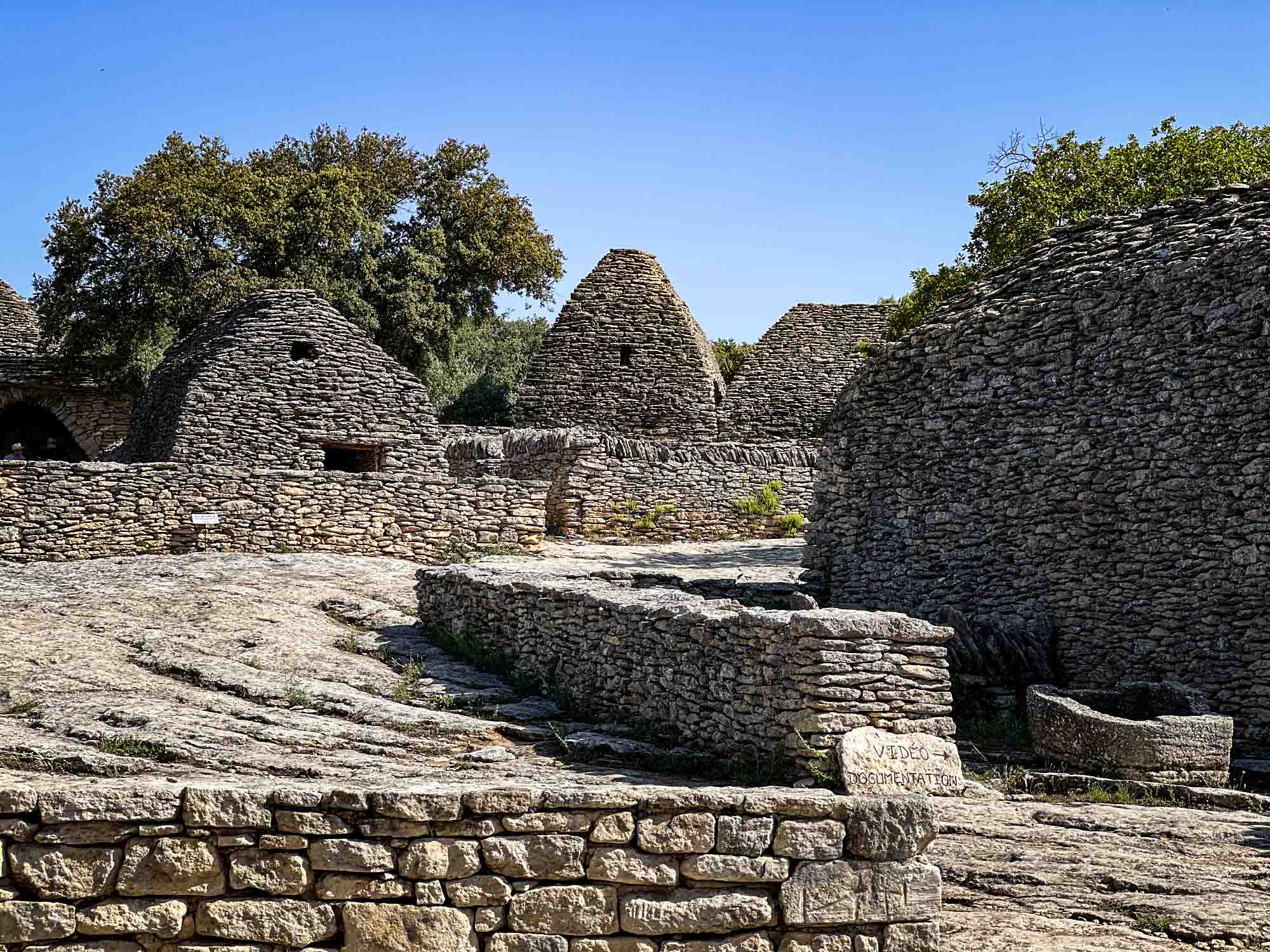
A few minutes from Gordes, the Village des Bories plunges you into a fascinating mineral universe, in the heart of the Luberon Regional Natural Park. This emblematic site, made up of dry stone huts, offers an exceptional testimony to the rural history of Provence and the ingenuity of the ancient builders.
Classified as a historical monument and organized as a rural housing museum, the Village des Bories invites you to go back in time through a rare architectural ensemble, perfectly integrated into the landscape of the Monts de Vaucluse.
Streets, enclosures, walls, sheepfolds, ovens and huts make up a singular setting where stone tells the profound link between man, the land and the constraints of a dry, demanding and yet intensely inhabited territory.
The Village of Bories is the largest group of dry stone huts in the Gordes sector, where there are several hundred buildings of this type in the surrounding countryside.

Formerly called Les Cabanes, this hamlet located about 4 km from Gordes corresponds to a form of temporary housing linked to seasonal agricultural work. It took place near cultivated land, in a logic of use, proximity and economy of resources.
The site testifies to the strong agricultural and pastoral activity that shaped the first slopes of the Monts de Vaucluse. Sheepfolds, wheat threshing areas, bread ovens, vats, walls and alleys tell the story of a rural world organized around the work of the land.
By visiting this place, we discover much more than a simple set of huts. We enter a landscape built, designed and transformed by generations of peasants, shepherds and builders.
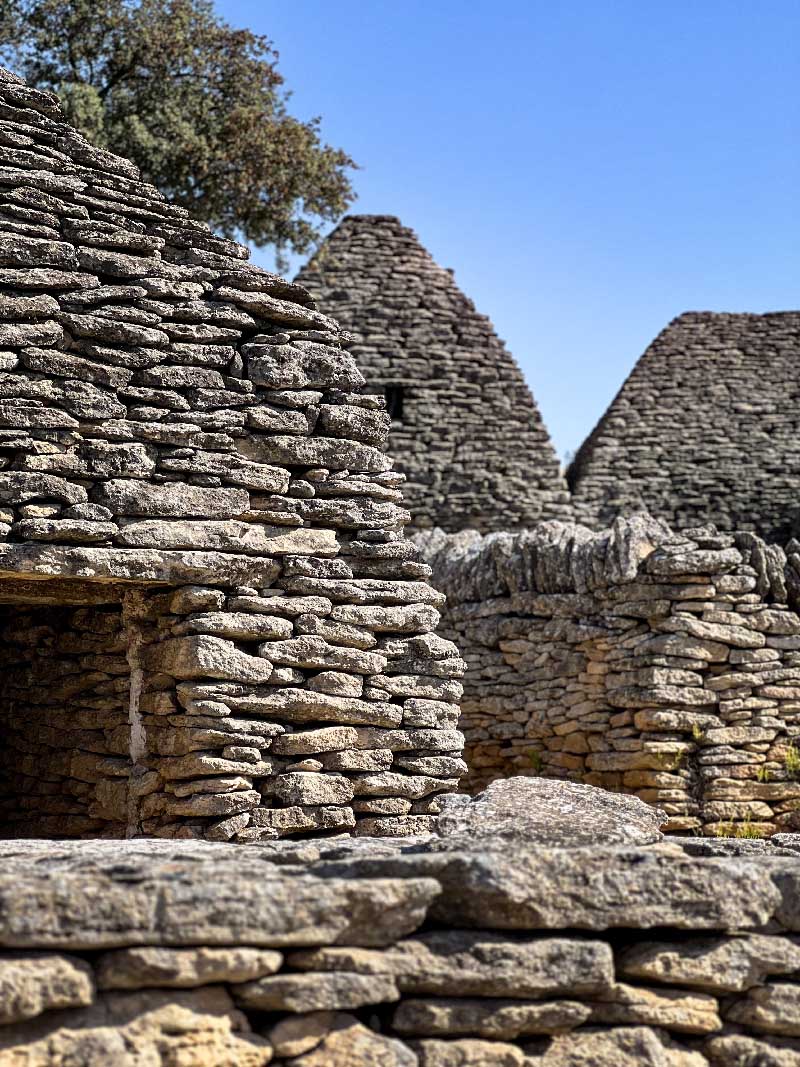
The dry stone technique is based on the careful assembly of stones without mortar or binder. Extracted directly from the ground during the clearing of the plots, they were reused on site to build walls, terraces, enclosures and huts.
This method, which is both simple and demanding, requires real mastery. The stones are chosen, adjusted and superimposed in order to ensure the stability of the whole, especially in the corbelled vaults which constitute one of the most remarkable features of these constructions.
Without transport, without cement and with materials found on site, dry stone illustrates a form of sustainability before its time, deeply linked to the environment and to peasant common sense.
The Village of Bories makes it possible to understand all the refinement of this art of building, transmitted for centuries and today admired for its simplicity, its resistance and its beauty.
In the region, the traditional term for these dry stone buildings is above all that of cabin, used for a long time by the inhabitants.
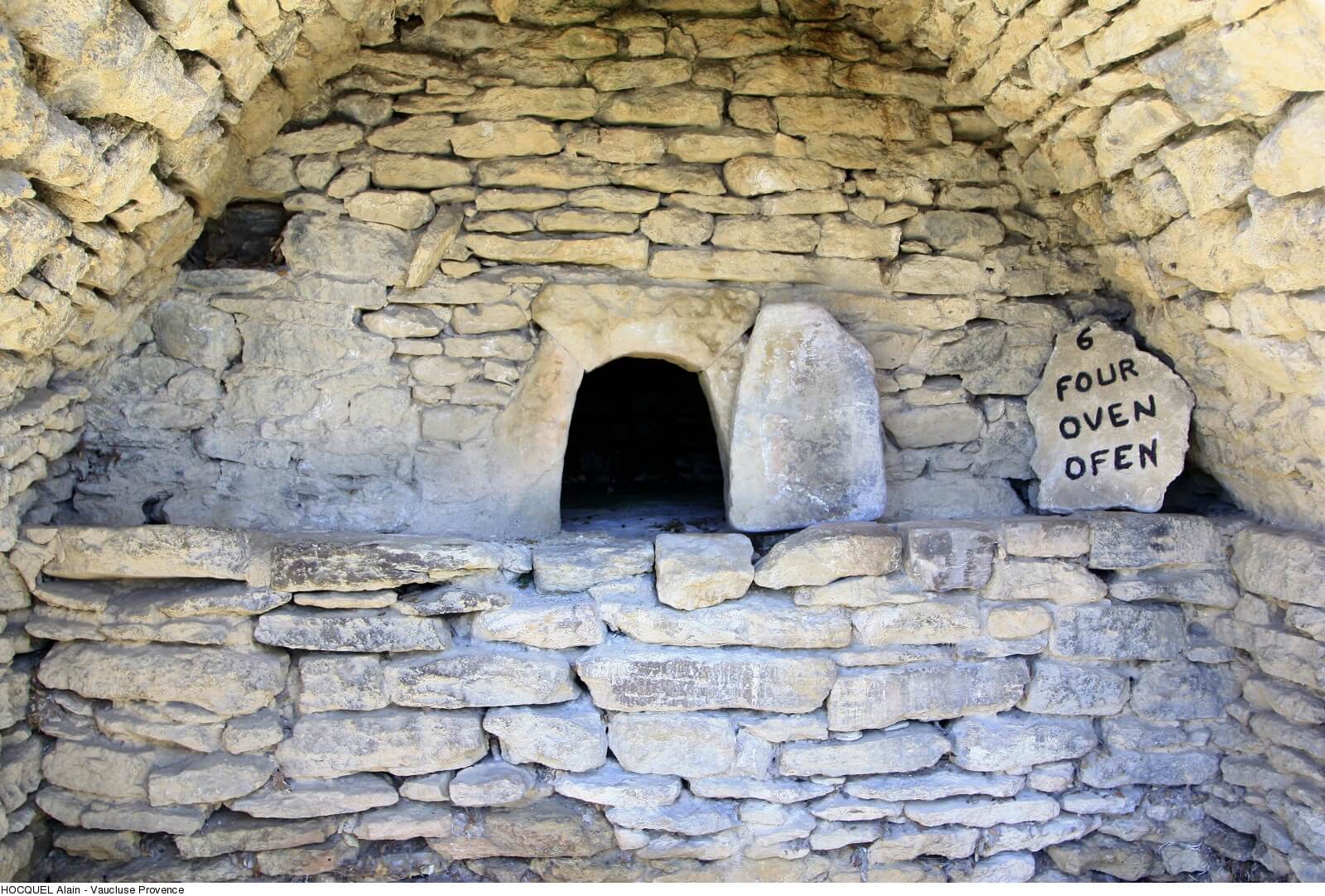
Today, however, it is the word Borie that has largely established itself in everyday speech. It is a French adaptation of the Provençal Bori, which originally referred to a farmhouse or a rural farm.
The word has its roots in medieval Latin boveria or boria, in connection with the idea of a stable or agricultural building. In use, it is found both masculine and feminine.
This vocabulary shift reminds us how these constructions are not only heritage objects, but also living fragments of Provençal language, culture and identity.
Abandoned at the end of the 19th century, the site fell into oblivion for a long time before being rediscovered in the 1960s by Pierre Viala, passionate about Provençal heritage.

At that time, the huts were invaded by vegetation and the lauzes had sometimes been plundered. Seduced by the strength of the place, Pierre Viala then undertook an important restoration work, with the concern to preserve the spirit of the site and the quality of its architecture.
This preservation operation has brought back to life an exceptional complex, which is now considered to be one of the most beautiful examples of rural dry stone housing in Provence.
The site was classified as a historic monument in 1977, then taken over by the town of Gordes in the 1980s, thus establishing the heritage recognition of this major site.

Now organized as a rural housing museum, the Village des Bories presents traditional objects and tools, as well as documentation devoted to the history of Gordes, bories and dry stone architecture in France and around the world. :ContentReference [oaicite:3] {index=3}
The visit allows you to better understand the uses of these huts, but also the logic of a landscape shaped by land clearing, the cultivation of poor lands, livestock, olive growing and other complementary activities related to Provençal peasant life.
While in Gordes, discovering the Village des Bories can easily be completed by visiting other major sites such as Sénanque Abbey, Gordes Castle or the Cellars of the Saint-Firmin Palace.
The site is also a good starting point for a walk in the landscapes of the Monts de Vaucluse, between rural heritage, nature and panoramas of the Luberon.
In addition to this article
Photo gallery


Practical information on Village of Les Bories
Opening times and periods
From 01/01 to 31/12/2026 daily.
Closed exceptionally on January 1st and December 25th.
- From 2 to 31 January, 10:00 to 17:00
- From 1 February to 29 March, 9:00 to 17:30
- From 1 April to 31 May, 9:00 to 19:00
- From 1 June to 31 August, 9:00 to 20:00
- From 1 to 30 September, 9 a.m. to 7 p.m.
- From 1 to 26 October, 9 a.m. to 6.30 p.m.
- From 27 October to 3 November, 9 a.m. to 5.30 p.m.
- 4 to 30 November from 9am to 5pm
- 1 to 31 December (closed on 25 December) from 10am to 5pm
Last admission 30 minutes before closing time.
Price(s)
Adult : 8 €
Child : 4 €
Student : 4 € (upon presentation of proof)
Group children : 2 €
Set price group adults : 7 €.
Free entry for children under 12.
Child entry valid for 12 - 17 years.
Group rate available for 10 people or more.
Free admission on presentation of proof : journalists, museum curators, art teachers and people with disabilities or reduced mobility.
Informations
EquipementsServicesLanguagesCustomers
Payment method

Frequently asked questions
What are the opening hours of the Village des Bories?
The Village des Bories is open every day, all year round, except on December 25th and January 1st. Opening hours vary depending on the season: Off-season (January to March and October to December): from 9:00 or 10:00 AM to 5:00 or 6:30 PM at the latest. Peak season (April to September): from 9:00 AM to 7:00 or 8:00 PM at the latest. Last admission: 30 minutes before closing time.
Are dogs allowed during the visit?
Yes, pets are allowed on the site, provided they are kept on a leash to ensure the peace of other visitors and the preservation of the site.
Is parking available on-site for visitors?
For cars, a free parking lot is located near the site entrance. For buses and motorhomes, mandatory parking is available along the D2 road. It takes approximately 20 minutes on foot to reach the Village des Bories. The path is accessible and pleasant, but sturdy footwear is recommended. For groups of more than 10 people only, a free shuttle service is provided by the town hall, except on Saturday afternoons, Sundays, and public holidays. Shuttle reservations must be made at least 15 days in advance by contacting the Gordes town hall.
Is the site accessible to people with reduced mobility?
Yes, the Village des Bories is partially accessible to people with reduced mobility, but assistance is required for certain areas due to uneven and rocky surfaces. All-terrain wheelchairs may be helpful for outdoor sections. For any specific questions, please do not hesitate to contact the reception before your visit at +33 4 90 72 03 48.
Is there a restaurant service at the Village des Bories?
No, but it is possible to have a picnic outside the site. You can also find many restaurants in the heart of the village of Gordes, located 4 km away.
What are the admission fees for adults, children, and groups?
Here are the admission fees for visiting the Village des Bories: Adult: €8 Child (12-17 years old): €4 Child (under 12 years old): Free Student (with valid ID): €4 Adult groups (10 or more people): €7 Children's groups: €2 Certain categories are granted free entry upon presentation of valid proof (journalists, museum curators, and individuals with disabilities).
Is it necessary to book in advance to visit the Village des Bories?
Booking is not required for individual visitors. However, it is recommended for groups to ensure a smooth visit. To make a reservation, contact the site directly or the Gordes town hall for school groups.


