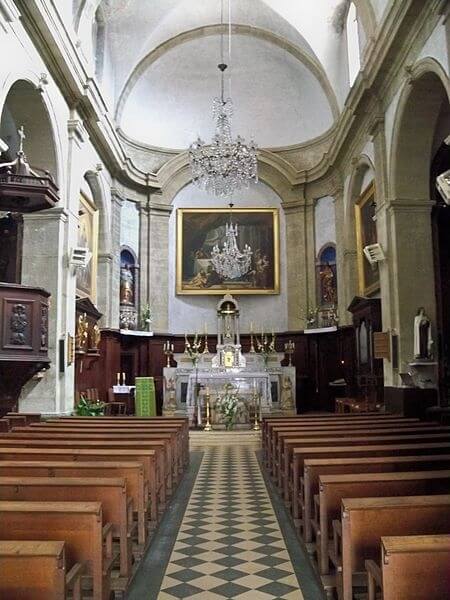
The church of Notre-Dame-de-la-Purification is the parish church in the commune of Lauris, in the Vaucluse. It has been listed as historical monuments since 1990.
Eglise notre dame de la purification, Place de l'église, 84360, Lauris
The Franque church, after the baptism of Clovis (496), continued Christianization in the countryside thanks to the monasteries. During this period, two churches were built in the commune of Lauris: Saint-Martin to the east and Saint-Jean to the west. After the death of Dagobert (638), the troubles that followed led the Laurisians to take refuge on the heights and build a third church under the patronage of Projet, bishop Auvergnat, who was murdered in 674.
Lauris had been included in the “Austrasian corridor”, which connected the Auvergne to Marseille, and kept the memory of it. The church is undoubtedly placed on the median that will become the Castle. As the lords seized Saint Projet, the Laurisians built a fourth church, Saint-Julien, inside the village, where they could bury their dead and gather their councils. In 1486, peace having returned, a fifth church was built, outside the ramparts, on the height to the east. She is under the patronage of Our Lady of Purification, in a century of great Marian devotion.


The church built by means of fortune, by a population of about 150 inhabitants, looted and burned by the Huguenots in 1562, threatens to fall into ruin at the end of the 17th century. Despite the difficulties of the time, a new sixth church (larger, with 2 sides, the only example in the canton of Cadenet, and a choir built beyond the ramparts), was built between 1702 and 1710, and retains the word of Notre-Dame-de-la-Purification. The church remained closed for some time after the French Revolution, because it was emptied of much of its objects. There are only four paintings and some liturgical objects from the 16th and 17th centuries, for the needs of the war.
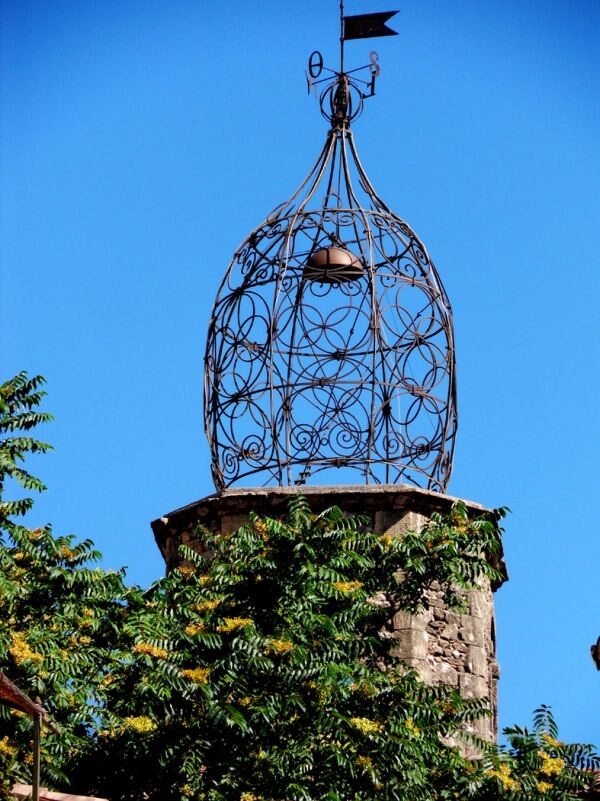
From 1830 to 1850, it was completely restored: restoration of the entrance gate, new statue of the Virgin on the façade, new stained glass windows beginning and other from the entrance, etc. In 1857, the installation of a ironwork structure on the bell tower for the installation of a clock stamp (drawing by Sollier, architect in Apt, manufacture of the Mousquet brothers. The Way of the Cross dates back to 1904, on a handmade basis.
On February 21, 1989, the church was inscribed as historical monuments. This inscription is cancelled by the Order of Classification of Historic Monuments of 22 November 1990. It is composed of 4 side chapels from the 18th century, around an eighteenth century nave, on the plans of the architect Aixois Vallon.
The façade has a niche with a statue of the Virgin of the nineteenth century. The church preserves a series of paintings: the penance of Madeleine to Saint Baume, the seventeenth century Virgin and the Child giving the rosary to St. Dominic and St. Catherine intercessors of the souls of Purgatory the Holy Family, Saint Anthony and Saint Eloi, the seventeenth century Mary Learning to read to the Child Jesus, signed John Christol, 1854 The Sacred Heart of Jesus, signed John Christol, 1855 The Presentation at the Temple of Saint Geneviève giving the sight to his mother The Assumption of the Virgin, 19th century Saint Martine Christ in agony in Gethsemia
Practical information on Church of Our Lady of Purification
Opening times and periods
Aucune information disponible
Price(s)
Informations
Languages